What Makes Containerized Water Treatment Systems Essential, and Why Choose QILEE?
Discover how compact, mobile, scalable water treatment technology helps industries, communities, and remote projects solve modern water challenges.

Introduction
Reliable water treatment is essential for protecting public health, supporting industrial operations, and reducing environmental pollution. However, traditional treatment plants can require significant land, civil construction, long installation periods, and permanent infrastructure. These requirements are not practical for every project.
This is where containerized water treatment systems provide a valuable alternative. By integrating treatment equipment into transportable container modules, these systems can deliver a compact and flexible approach to water purification, wastewater treatment, desalination, and water reuse.
QILEE offers containerized solutions designed for different applications, including drinking water, purified water, high-purity water, process water, wastewater, and water reuse. Its systems combine modular engineering with technologies such as membrane filtration, reverse osmosis, biological treatment, automation, and smart monitoring.
What Are Containerized Water Treatment Systems?
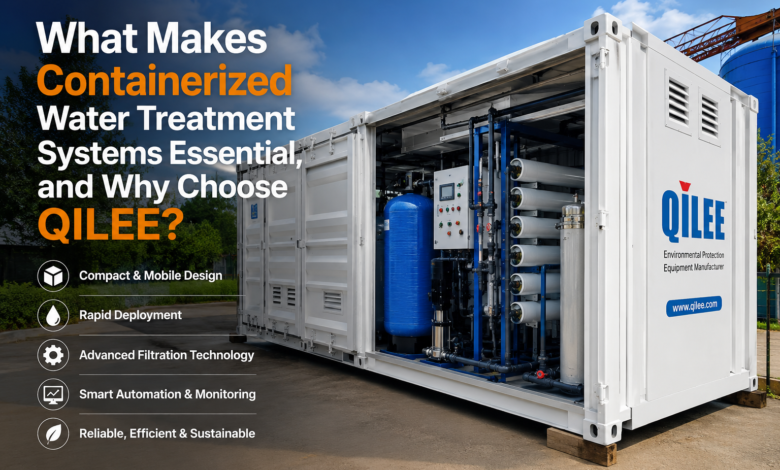
A containerized water treatment system is essentially a water treatment plant assembled inside a standard shipping container or a series of integrated modules.
Instead of constructing every component at a project site, much of the equipment can be assembled and tested before delivery. Depending on the application, a system may contain filtration equipment, pumps, chemical dosing equipment, membranes, biological treatment units, disinfection equipment, control panels, and monitoring technology.
The result is a compact treatment solution that can be transported to a location and connected to the required water supply, power, and discharge or reuse infrastructure.
QILEE states that its containerized systems can integrate biochemical reaction units, membrane separation and filtration technologies, intelligent pumps and valves, and IoT-based smart control systems.
Why Are Containerized Water Treatment Systems Essential?
1. Faster Deployment
One of the biggest advantages is the potential for faster installation compared with conventional civil-built treatment infrastructure.
Traditional plants can involve extensive excavation, concrete work, equipment installation, and commissioning. Containerized systems reduce much of this site work because major components are integrated before delivery.
This can be particularly useful when water treatment is urgently required or when a project has a limited construction schedule.
QILEE describes its containerized wastewater systems as pre-assembled units that can be transported and installed with relatively limited on-site work.
2. Efficient Use of Space
Land availability can be a major challenge for industrial facilities, construction projects, remote communities, and urban developments.
Containerized systems use a compact footprint and can place multiple treatment processes within organized modules. This makes them suitable for locations where building a large conventional treatment plant would be difficult.
A smaller footprint can also reduce the amount of civil infrastructure required around the treatment system.
3. Mobility and Relocation
A permanent treatment plant is generally designed for one location. Containerized systems offer a different approach.
Because the treatment equipment is housed in transportable modules, it can potentially be moved when project requirements change. This makes the concept particularly useful for temporary projects, remote industrial operations, construction sites, mining locations, and emergency applications.
QILEE specifically highlights mobility and relocation as important features of its containerized systems.
4. Modular Scalability
Water demand does not always remain constant. A facility may begin with a relatively small requirement and later need additional capacity.
Modular treatment allows capacity to be expanded according to project requirements. Additional modules or treatment stages can potentially be incorporated without completely replacing the original system.
This flexibility can be valuable for businesses planning future expansion or communities experiencing changing water demand.
5. Reduced On-Site Construction
Because equipment can be prefabricated and integrated before arriving at the destination, containerized systems can reduce the amount of construction required at the installation site.
QILEE describes its approach as pre-fabricated and integrated, with controlled manufacturing and engineering intended to support consistent system construction.
Less on-site construction can simplify project logistics and potentially reduce disruption to an operating facility.
What Technologies Can Containerized Systems Use?
A containerized system is not limited to one treatment technology. The appropriate configuration depends on the source water, contaminants, required treated-water quality, capacity, and intended use.
Reverse Osmosis
Reverse osmosis, commonly known as RO, uses membranes to remove many dissolved substances from water. It is widely used in desalination and high-quality water production.
QILEE offers containerized RO solutions for applications including pure water, seawater desalination, and water reuse.
Ultrafiltration
Ultrafiltration, or UF, can provide membrane-based separation for water purification and pretreatment applications. It can be combined with other treatment technologies depending on the required water quality.
Biological Treatment
Biological processes use microorganisms to break down biodegradable organic matter in wastewater. Containerized biological systems can be useful where wastewater treatment is required but permanent infrastructure is limited.
Disinfection
Disinfection is an important final treatment step when treated water must meet appropriate microbiological requirements. The specific method depends on the application and applicable water-quality standards.
Why Choose QILEE?
Choosing a containerized water treatment system is not simply about purchasing equipment inside a container. The treatment process needs to match the actual characteristics of the incoming water and the required quality of the treated output.
QILEE positions its solutions around customized and scalable treatment systems rather than a single universal configuration. Its portfolio covers municipal, industrial, drinking-water, purified-water, high-purity, desalination, wastewater, and water-reuse applications.
Customized Treatment Solutions
Different water sources create different treatment challenges. A system designed for seawater may require a very different process from one treating industrial wastewater.
QILEE states that its systems can be customized according to raw-water characteristics and customer requirements.
Smart Automation
Modern treatment plants increasingly depend on automation to improve operational control.
QILEE’s containerized systems incorporate intelligent control options, including PLC and HMI-based operation on certain equipment, while some systems offer remote monitoring capabilities through communication technologies.
Compact and Integrated Engineering
Integrating multiple treatment stages into a container can simplify the overall system arrangement. QILEE combines treatment equipment, pumps, valves, filtration technologies, and control systems within modular designs for different applications.
Suitable for Different Environments
Containerized systems can be especially attractive where conventional infrastructure is difficult to build. Remote industrial sites, temporary projects, rural communities, construction locations, and facilities with limited available land can all potentially benefit from modular treatment approaches.
What Should You Consider Before Choosing a System?
Although containerized systems offer many advantages, the correct design still depends on technical requirements.
Before selecting a supplier, consider:
- Source-water quality and contaminants
- Required treatment capacity
- Required treated-water quality
- Energy availability
- Available installation space
- Climate and environmental conditions
- Waste or sludge management
- Required automation level
- Maintenance requirements
- Local water-quality regulations
- Possibility of future expansion
A professional supplier should evaluate these factors before recommending the treatment process.
Containerized Systems vs Traditional Treatment Plants
The key difference is flexibility.
Traditional treatment plants can be excellent choices for large, permanent installations where substantial land and civil infrastructure are available. Containerized systems are more attractive when speed, mobility, compactness, modularity, or reduced site construction are priorities.
QILEE reports that its containerized approach is designed for rapid deployment, factory prefabrication, intelligent monitoring, relocation, and modular expansion. These are manufacturer-stated capabilities, so project-specific performance should always be confirmed through engineering specifications and testing.
Conclusion
What Makes Containerized Water Treatment Systems Essential, and Why Choose QILEE? The answer lies in flexibility, mobility, compact design, scalable capacity, and the ability to integrate different treatment technologies into a coordinated system.
For projects that cannot rely on a large permanent treatment plant, containerized technology can provide a practical path toward reliable water purification or wastewater treatment. QILEE stands out in this field by offering customized containerized solutions across drinking water, purified water, industrial process water, wastewater, desalination, and water reuse applications.
The most important step, however, is choosing a system based on actual water quality and project requirements rather than simply selecting the smallest or most convenient unit. With appropriate engineering, treatment technology, automation, and ongoing maintenance, a containerized water treatment system can become a flexible part of modern water infrastructure.